Ever been exasperated when your meticulously crafted AI model spews out answers that seem as though it was poking around in the dark? Confusion stems from the AI’s struggle to comprehend raw data, as it’s akin to a foreign language without context or meaning. Enter semantic layers – a translator that imparts wisdom to data.
These levels enhance comprehensibility by contextualising the raw data, weaving in relevancy and interpretability. With this introduction to semantic layers, whether you’re a data scientist, an AI engineer or a curious reader, we journey into examining why these frameworks are pivotal in shaping the discourse around data interpretability.
The Metaphor of Semantic Layers: Not a Database, But a Map
Is a semantic layer another type of database? Not quite. Instead, let’s liken it to a detailed map that navigates relations, meanings, and contexts in the dynamic ocean of raw data. Just as towns, cities, and highways on a physical map aren’t the terrain itself but a representation of it, a semantic layer exists above the unorganised trove of disparate data sources, helping you decode their complexities with relative ease.
The actual essence of a semantic layer comes in its functionality to transform raw data into understandable business terms, akin to how a map simplifies complicated geographical terrains for travellers. And just as a single map can be used to navigate various regions, a semantic layer abstracts the diverse sources of data into a unified, user-friendly relational model to facilitate better data interpretation.
But don’t confuse a semantic layer with traditional database schemas. A database schema focuses solely on the structure, guided by the technical know-how of data storage. In contrast, a semantic layer adds an additional level of complexity, looking at the business logic, definitions, and relationships between data elements. Think of it as a compass guiding you through your data landscape, ensuring you don’t lose your way amidst the chaotic churning of raw data torrent.
Shattering the BI Dashboard Myth: Semantic Layers and AI
Semantic layers hold significance far beyond fulfilling the aesthetic needs of Business Intelligence dashboards. This misplaced perspective underestimates their strategic value to AI. Surely, they add charm to BI by offering consistency and context. But consider this – if they are capable of such orchestration for static reports, imagine their potential when applied to dynamic entities like machine learning models, natural language processing, and advanced analytics.
In reality, these layers carry the heft of producing an intelligent, context-rich foundation of data. What seems to be a simple BI enhancement harbors the potential to thrust AI applications into new frontiers. So, nearing these layers as a mere component of traditional Business Intelligence is akin to viewing the tip of an iceberg while ignoring the vast ice mass submerged beneath. Consequently, to truly grasp their profound contribution, widen your scope to see them as a broad strategic tool propelling the future of AI.
Semantic Layers: The Underpinnings of Intelligent AI
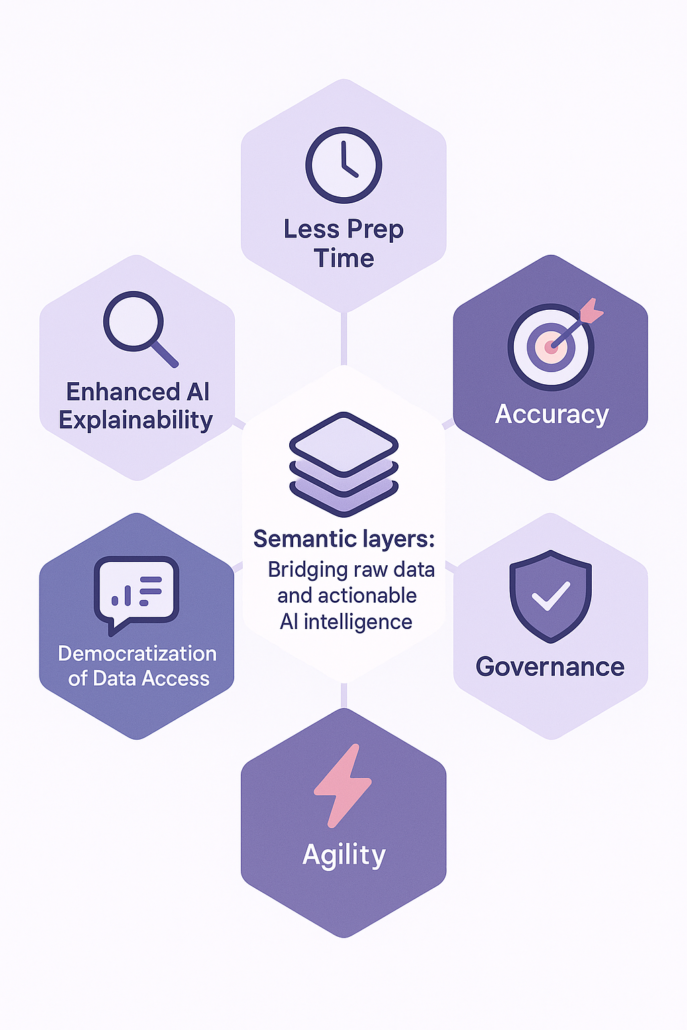
Let’s dissect the potential of semantic layers in bolstering AI applications. Each advantage stands distinct, underscoring how these layers are an unsung hero for AI’s future.
- Highlight number one: Semantic layers boost AI explainability. Machine learning models can grasp the context better thanks to these layers translating complex data into understandable business terms.
- Benefit two is all about time-saving. Harmonized data in the semantic layer shaves off significant amounts of preparation time. The data arrives already understood, primed for consumption by AI models.
- Better accuracy of machine learning models is the third feather in semantic layers’ cap. Featuring consistent, high-quality attributes, they can enhance model precision.
- On to advantage number four: the democratization of data access. The use of natural language to query data becomes possible, enabling even non-tech savvy business users to explore information.
- Benefit five lies in agility. A faster iteration and deployment of models is enabled thanks to these semantic layers. AI evolution becomes fluid and quick-paced.
- Lastly, let’s not forget data governance and compliance, made robust by semantic layers. Crucial rules are enforced in the semantic layer, ensuring all data manipulations adhere to relevant regulations and standards.
Each point caves a path towards a more intelligent, accessible, and ethical AI – testament to the indispensable role of semantic layers. Their significance seeps into every layer of AI application, shaping a future that’s not only more effective, but also more understandable and trusted.
Semantic Layers: Translating AI’s Foreign Language
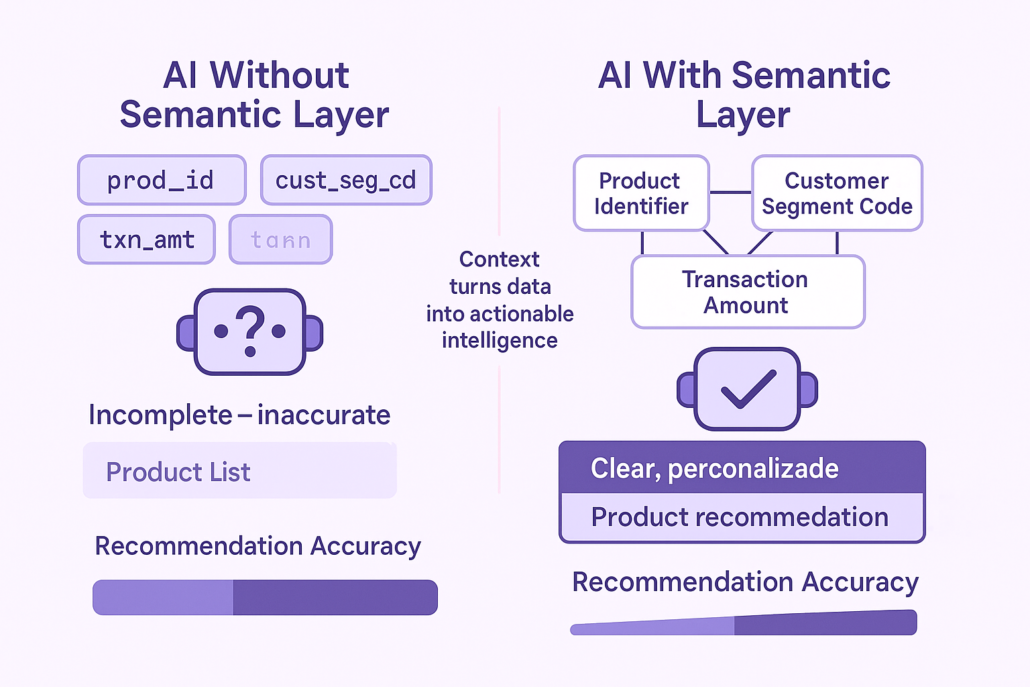
Let’s say you run an e-commerce company. You’re trying to build an AI model for personalized recommendations. However, your AI model is reading something alien: ‘prod_id’, ‘cust_seg_cd’, ‘txn_amt’. It struggles to make sense of these cryptic terms and their relationships. This is where a semantic layer steps in.
With a semantic layer, the model starts interacting with data in a human-like language. ‘Product Identifier’, ‘Customer Segment Code’, ‘Transaction Amount’ become the new lexicon. It learns that ‘customer_segment’ influences ‘product_preference’. This new understanding unleashes the power of your AI model to make intelligent and explainable recommendations.
Picture this. Without a semantic layer, your AI model is like a foreigner lost in a new city, trying to decipher street signs written in an unfamiliar language. But when a semantic layer is introduced, it’s like the same foreigner now has a handy translation app.
Suddenly, the foreign city is not so strange and confusing anymore. The string of cryptic codes now makes sense – they represent products, customer segments, transaction amounts. And understanding these relationships, your AI service can now make more accurate, satisfying recommendations to your customers. It’s a bit like handing your AI model a Rosetta stone for your business data.
So the introduction of a semantic layer doesn’t just improve the precision of your AI model; it significantly advances the ‘intelligence’ of artificial intelligence by improving its comprehension and application of complex data. It allows your AI to not just ‘speak’ but truly ‘understand’ the language of your business.
Steps to Implement Semantic Layers
So, why are semantic layers important for AI? It’s simple. They pave the way for AI systems to better understand and consume complex data. Now, let’s delve into the essential steps to implement semantic layers in your organization.
1. Start with the Business Glossary. Terms matter. Much like learning a new language starts with vocabulary acquisition, understanding and defining business terms comes before any technical work. This clarity tends to simplify technical tasks down the line.
2. Next, an incremental approach to adoption is vital. Trying to semantic-layer everything in one go is akin to swallowing a large pill – unlikely to go down easily. Break down the implementation into manageable chunks instead.
3. Tool selection comes third. Platforms like Edubrain can be useful companions on this journey, providing solid foundations for building and managing your semantic layers. They should be integrated naturally into your workflow for managing complex data structures.
4. Fostering collaboration across teams constitutes the fourth step. This isn’t just a task for the tech team. Involving business teams can bridge the gap between technical complexity and clear business logic, fostering better overall outcomes.
5. Finally, don’t forget governance. Establishing clear ownership and processes for updates is crucial for maintaining your semantic layers. A well-governed semantic layer is like a well-organized library – easy to navigate and use.
By following these steps, you can make the most of semantic layers for AI. Prevail over the challenges and reap the rewards, making AI more accessible, understandable, and effective.
Semantic Layers: A Strategic Imperative for AI’s Future
The fundamental role of semantic layers in the architecture of AI systems cannot be diminished to merely a technical detail. What they bring is a strategic edge in designing more resilient, explainable, and truly intelligent AI. A robust semantic foundation is an irreplaceable component for AI, not solely for pattern recognition, but for in-depth understanding.
It’s high time we view semantics not just as an add-on feature, but as a bedrock to AI’s evolution. As we advance further into an era where AI’s understanding is as important as its predictive capabilities, the power of semantics will be essential to progress.
Embrace Semantic Layers: Fostering AI That Understands, Not Just Computes
Semantic layers are more than just an evolved technique for data management. They are a powerful lens that refines the way AI reads, interprets, and utilizes data.
Meaningful data, enhanced through semantic layers, grants AI the ability to comprehend–a characteristic that moves them beyond mere prediction machines. As we envision an AI-dominated future, investing in semantic layers translates into investing in smarter, more reliable AI systems.
Building these layers into your AI strategy can amplify the depth of intelligence your systems possess. Remember, when data speaks, an AI with a semantic layer listens. Let’s not make our future AI deaf to the language of data.